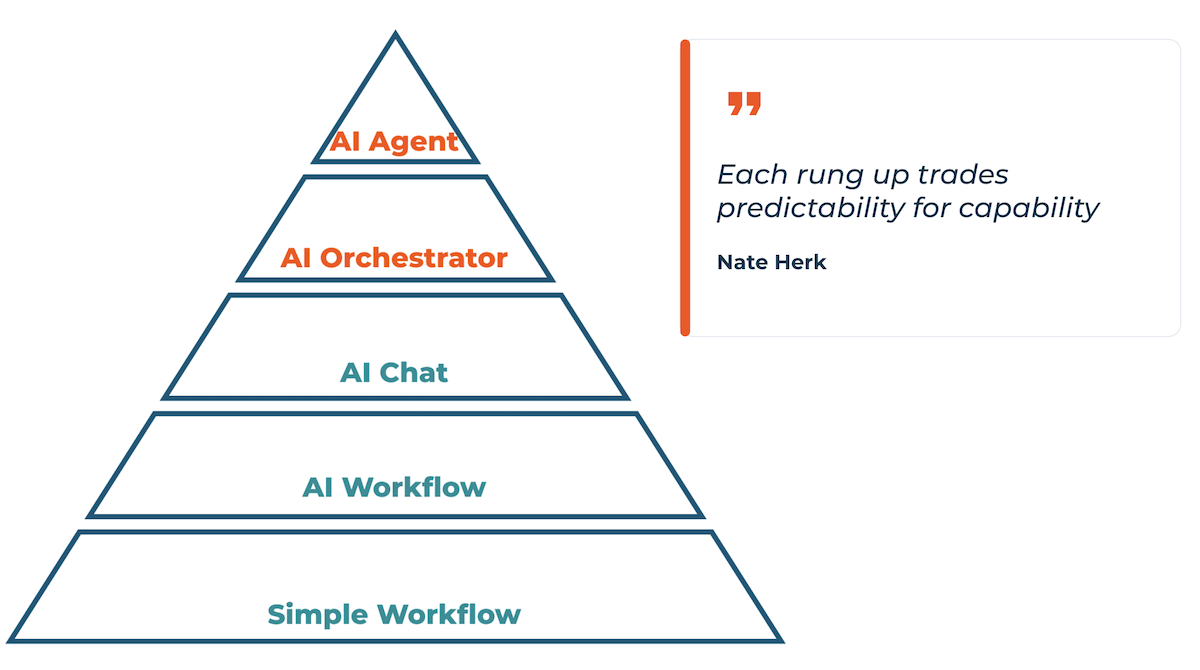
In the AI automation space, I follow Nate Herk very closely. He’s a brilliant builder and teacher. In his book, "Becoming AI Native" (which anyone serious about building with AI should read), he breaks down the range of AI systems into a pyramid.
I love this visual. It starts with the simplest form of automation at the bottom, and then each level up the pyramid relies more on AI to complete the workflow.
Nate’s quote that sold me was, “Every level up trades predictability for capability.” In other words, because AI is more involved at each level, it can do more, but how and why becomes more of a mystery.
Where I slightly deviate from Nate is what the pyramid layers are. I see the pyramid as a range of how much choice AI has in figuring out how to get the work done.
The goal isn't to get everything to Level 5. It's to use the simplest system that can reliably get the job done. But as you build those simpler systems, you're also creating the infrastructure that makes the higher levels increasingly more reliable.
For the last three years, I’ve lived at levels 1-3. I was chatting with AI on strategic or first-time projects, and then building Make.com automations with AI baked in to handle all kinds of routine subtask-level work.
At the beginning of this year, I started building AI orchestrators and that was a huge unlock for me. All of a sudden I could ask AI to complete a specific task and it had the skills, consolidated resources, and a tool structure to do the job and hand me a finished product for review.
Recently, I’ve started to use always-on agents, specifically Grokbot. Grokbot now sits on an infrastructure of automations and skill documentation that’s been refined with AI over the last 11 months.
It’s now my chief of staff. I’m also in the process of setting up my side hustle to operate mostly through a team of agents that work with human owners. More on that to come in a future email, because it’s messier than people make it look. But it is very exciting.
Three years ago, I wasn't building infrastructure for AI agents. I was just trying to automate repetitive work and get AI to reliably complete individual tasks.
It turns out that all the boring work of documenting processes, connecting systems, organizing data, and building automations is exactly what made the jump to agents so much easier.
Grokbot didn’t have to invent its own way of doing things. It didn’t spin up its own scripts, guess at my processes, or patch together workarounds I’d have to untangle later. It plugged into systems I’d already built, tested, and trusted, and started running.
That’s the difference between an agent that runs part of your business and an agent that quietly builds a second, shadow version of it.
So if agents feel out of reach for your business, don’t start there. Start with one repetitive task. Document it, automate the predictable parts, and connect it to the tools your team already uses.
Every reliable workflow you build today gives an agent more to work with tomorrow.
Transform your small business with simple, practical AI and automation tips delivered right to your inbox every week.

L2 Digital © All Rights Reserved 2026
Privacy Policy

